HOLOLIFE Longevity Côte d'Azur
Integrative Medicine Approach to Health Optimization
By Teemu Arina · · Updated
A Monaco Wellness Entrepreneur Argued In Nice That The Future Of Healthcare Would Depend On Precision Diagnostics, Nervous System Regulation, And A More Human Vision Of Longevity
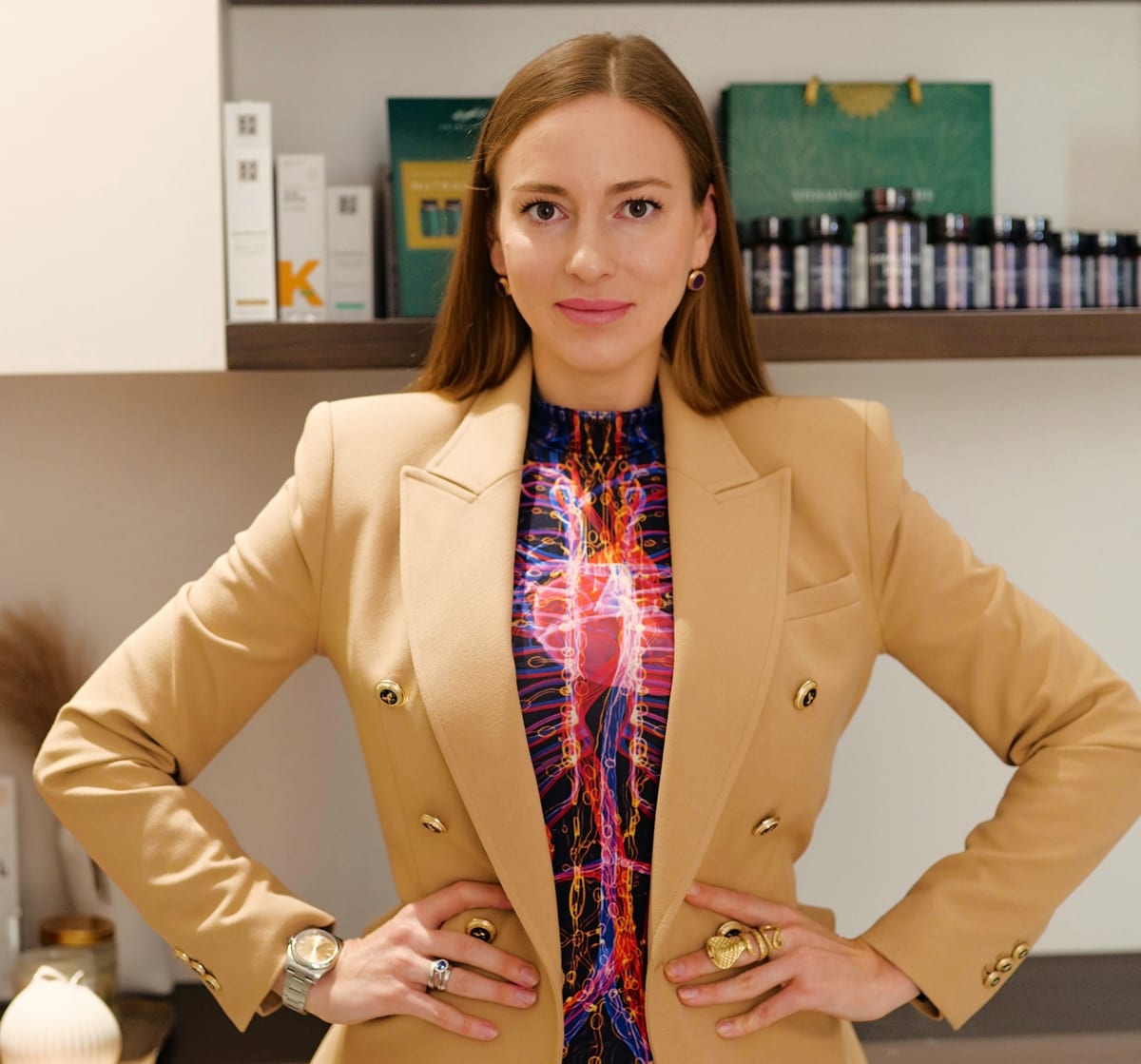
At Hololife Longevity Côte d'Azur in Nice, France, on 12 March 2026, Marina Matkova-Jahlan stepped onto the stage with a message that cut against the sleek anxiety often surrounding the longevity industry. Health, she suggested, would not be secured by obsession alone, nor by a single molecule, device, or pharmaceutical breakthrough. It would be built through an integrative medicine approach that treated the person as an ecosystem, not a malfunctioning machine.
Matkova-Jahlan, founder of ANIMA CORPUS MONACO, brought to the event the hybrid authority of a biochemist, Harvard neuroscience alumna, and medical concierge practitioner working with high-net-worth individuals and families. Her presentation, titled Integrative Medicine Approach to Health Optimization, fused clinical language with spiritual cadence, diagnostics with ritual, and personalized supplements with a broader social argument about how healthcare might evolve.
A Person-Centered Model Beyond Conventional Care
The core of her argument was that modern healthcare had too often become reactive, fragmented, and impersonal. Integrative medicine, she said, offered a different path: preventative, personalized, and client-centered.
Drawing on her work through ANIMA CORPUS MONACO, Matkova-Jahlan described a model in which conventional medicine, functional testing, nutrition, wellness protocols, and lifestyle interventions were not competing ideas, but parts of a wider framework. The aim was not simply the treatment of disease, but the optimization of vitality.
She framed this approach as a response to a broader crisis of trust and effectiveness in healthcare. Her own role, she noted, was not that of a physician but of a practitioner trained in healthcare and nutrition, working at the intersection of science-backed wellness and individualized support.
The Body As Data, The Patient As Individual
If the philosophy was expansive, the methodology was exacting. Matkova-Jahlan described a diagnostic system built on laboratory analysis of stool, urine, and saliva, with samples sent to Germany for assessment. These tests, she said, allowed her team to examine heavy metals, mineral status, and neurotransmitters including dopamine, serotonin, and GABA.
From that data, she built personalized protocols for clients, combining medical checkup assistance, supplements, and wellness treatments. The promise was customization at a fine-grained level: not generic wellness, but tailored intervention.
This precision, in her telling, was what made the integrative model compelling. One client’s fatigue, anxiety, or hormonal imbalance might not resemble another’s, even if the symptoms appeared similar on the surface. The task was to read the chemistry, understand the context, and respond accordingly.
Supplements, Mitochondria, And The Limits Of Hype
The supplement culture surrounding longevity often trades in grand claims. Matkova-Jahlan tried, at least rhetorically, to position herself somewhere more measured. She spoke of liposomal multivitamins, collagen, magnesium threonate, and alpha R lipoic acid as tools rather than miracles.
Her particular emphasis fell on nutritional balance before enhancement. Boosting mitochondria, she argued, made little sense if the body was already running on deficiencies. In that context, she cast liposomal alpha R lipoic acid as a softer alternative to NMN, especially relevant in Europe, where NMN remained restricted.
The point was less that supplements were unimportant than that they had to be embedded in a broader system. Longevity, in this account, could not be bought in capsules alone.
Vagal Stimulation, Stillness, And The Science Of Doing Nothing
One of the most striking moments in the presentation came not in a chart or case study, but in a guided meditation. Matkova-Jahlan invited the audience into a brief somatic exercise, asking them to breathe deeply, touch their bodies, and return their attention inward.
“Touch this awesome avatar, this awesome machine,” she said. “Get back into your body and feel the expansion. You are on the edge of the universe, expanding with the air inside of you.”
This was not stagecraft for its own sake. She presented the exercise as a form of vagal stimulation, a means of regulating the nervous system and, in her words, establishing “the basics of longevity.” The language drifted easily between neuroscience and mysticism, but the underlying proposition was clear enough: a dysregulated nervous system undermines health, and stillness can be therapeutic.
She made the point again in simpler terms. “Doing nothing is incredible for longevity,” she said. “It is well studied that if you take some time every day to do nothing, it is very beneficial for your nervous system.”
In an industry built on optimization, tracking, and relentless intervention, it was a quietly radical suggestion.
Collective Healing And The Return To The Soil
Matkova-Jahlan also widened the frame beyond the individual. Her version of wellness was not only personal but communal, tied to what she called an “ecosystemic approach.” Through work in Monaco, including tree-planting initiatives and partnerships with foundations and public institutions, she argued that health could be cultivated collectively.
“When you work with the soil, beneficial bacteria boosts your serotonin,” she said. “This is how we practice collective healing: reconnecting with the earth to promote well-being.”
The idea, at once biological and symbolic, captured much of the spirit of the talk. Healing was not merely a private consumer project. It was something enacted in relationship: with family, with community, with environment, with the living world itself.
That claim may have sounded lofty, but it was anchored in her practical description of how care often spread through households. One client, she said, would improve, then bring a spouse, then a parent, then children. Wellness, in practice, traveled through networks of trust.
Isolation, Vision Quests, And Recalibration
No part of the presentation pushed further beyond mainstream medicine than her description of “vision quests,” which she said she undertook twice yearly in the mountains above Nice. Borrowed from ancient Indigenous traditions, as she described them, these involved several days of isolation in nature, fasting, and near-total stillness.
“Isolation in nature allows for a powerful resetting and recalibration,” she said. “You reconnect with yourself and understand that you can go beyond your perceived limits to find balance.”
For Matkova-Jahlan, such practices belonged within a serious conversation about health, not at its margins. They were part of a wider effort to recalibrate the nervous system, sharpen self-awareness, and break through what she saw as the fear-driven psychology of much longevity culture.
Fear, Longevity, And A Different Future For Healthcare
That critique of fear sat near the moral center of the talk. Too many clients, she said, arrived wanting a pill that would let them live forever. The fantasy was less about health than about avoidance, less about flourishing than about fear of decline and death.
Her answer was not anti-technology. She spoke positively about AI, wearables, diagnostics, and new ventures in wellness and medical concierge services. She also argued that governments and industries would need to be engaged if lasting change were to happen. Food systems, reimbursement models, and even pharmaceutical thinking, she suggested, could be nudged toward a more preventive and integrative logic.
But she insisted that no amount of innovation would replace the need for human touch, embodied awareness, and inward work. “Consolidate your heart and brain center,” she told the audience during the meditation. “Go beyond energy and find the stillness within. This is the vagal stimulation that forms the basics of longevity.”
The Longevity Conversation Beyond Biohacking
What Matkova-Jahlan offered at Hololife Longevity Côte d'Azur was not a tidy doctrine. It was a collage of diagnostic science, supplement strategy, somatic practice, nature immersion, and systems thinking. At times it hovered between laboratory rigor and spiritual aspiration. Yet that tension was precisely the point.
Her presentation argued that health optimization would not come from choosing between medicine and wellness, data and intuition, innovation and ritual. It would come from learning to hold them together. In Nice, she made the case that the future of longevity might depend less on escaping the body than on returning to it.
Frequently asked questions
What does an integrative medicine approach mean here?
Treating the person as an ecosystem rather than a machine: precision diagnostics and personalized supplements combined with nervous system regulation, stillness, nature and community, in Matkova-Jahlan's concierge practice in Monaco.
Who is Marina Matkova-Jahlan?
Founder of ANIMA CORPUS MONACO, a biochemist and Harvard neuroscience alumna who works as a medical concierge practitioner with high-net-worth individuals and families.
What did she say about supplements?
That they have a place when guided by data and mitochondrial needs, but that hype around single molecules distracts from regulation of the nervous system and the basics of recovery.
About the event
This recap is part of the HOLOLIFE Longevity Côte d'Azur series, recorded in Nice on 12 March 2026. Read the summary of the whole day or join the next edition, HOLOLIFE Summit 2026 Amsterdam, on 14 and 15 November 2026.
In this story
Comments
Loading comments…